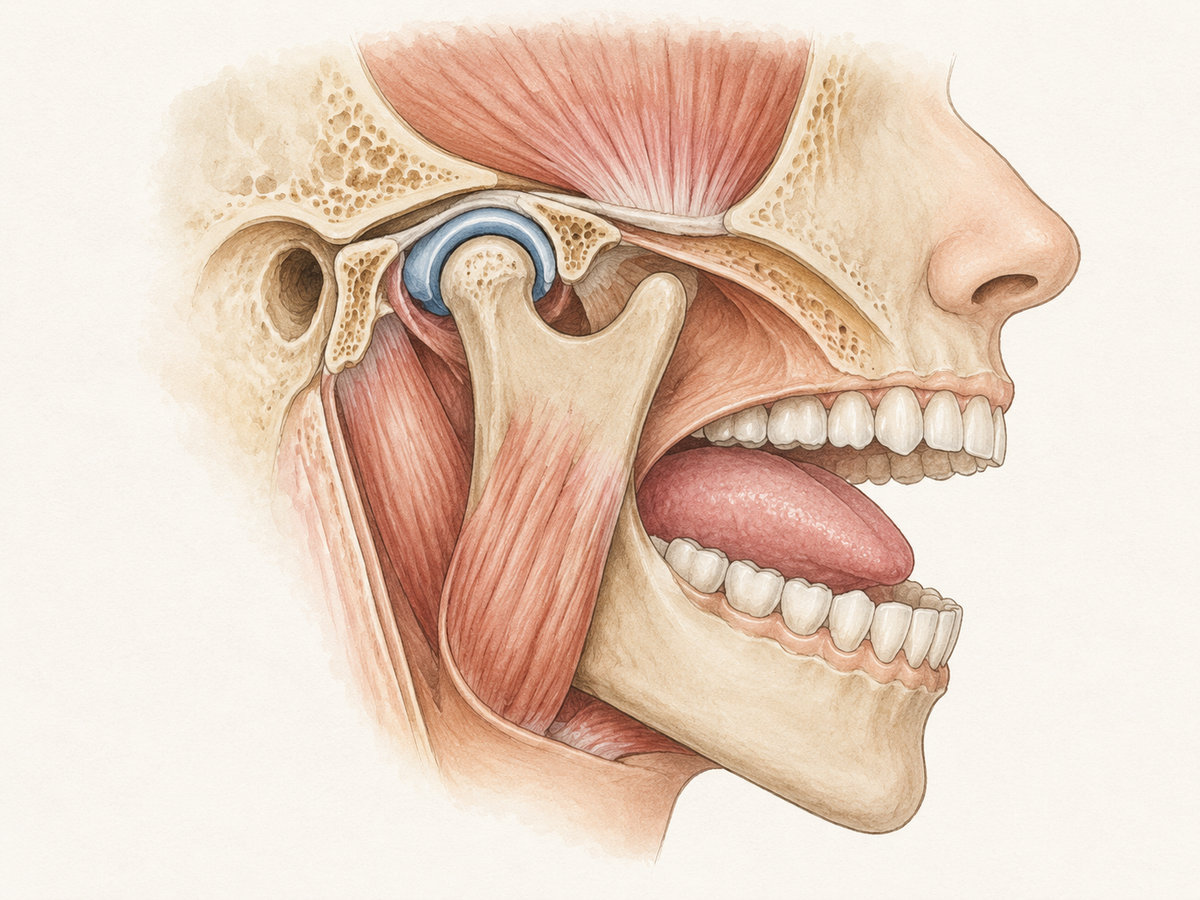
Yes, gentle jaw exercises can help relieve TMJ pain by relaxing tight jaw muscles, taking pressure off the jaw joint, and restoring smoother, more even movement. The routine below takes about 10 minutes and should feel mild, not like a hard workout. Stop any movement that causes sharp pain, and see a dentist or doctor first if your jaw locks, has recently been injured, or is swollen.
The main thing to know: Gentle, pain-free movement is the goal. Consistency matters more than intensity. If symptoms worsen or do not improve within 2–3 weeks, get a professional evaluation.
What These Exercises Can Do
The temporomandibular joint is the hinge on each side of your face that connects your lower jaw to your skull. People often say “TMJ” when they mean temporomandibular disorders (TMD), a group of conditions that cause jaw pain, tightness, clicking, or limited movement.
Jaw exercises are not a cure for every jaw problem, but they are a sensible first step for many people. Current clinical guidance on TMD treatment suggests self-mouth-opening exercises as a conservative, reversible first step for jaw muscle and joint pain, though the supporting evidence is still graded as low certainty. A large evidence review also found that supervised jaw exercise and stretching can help relieve chronic TMD pain and improve jaw function. The key word is “gentle.” These exercises aim to relax muscles and improve movement, not to force the joint.
Before You Start: Safety Check
TMJ exercises are generally safe, but they are not right for every jaw problem. See a dentist or doctor before starting if you have any of these symptoms:
- Your jaw gets stuck in an open or closed position.
- You recently had a blow or injury to the jaw or face.
- You have major swelling in the jaw or face, or you have a fever.
- Your pain keeps getting worse instead of improving.
- You feel sharp pain during any jaw movement.
These can be red flags for infection, trauma, or another condition that needs professional attention, according to guidance on managing painful TMD. If none apply, start with a warm compress over the tight area for 5–10 minutes. Sitting in front of a mirror helps you watch for straight movement. Keep everything slow, and stop at the first sharp pain.
First: Relax and Decompress the Jaw
Decompressing means giving the jaw joint a little space so the surrounding muscles can relax before you stretch.
Start with your resting jaw posture:
- Let your lips touch lightly.
- Keep your teeth slightly apart.
- Rest your tongue lightly on the roof of your mouth, just behind your upper front teeth.
- Keep your face and neck relaxed.
This is called the mandibular rest position, or the natural relaxed position of your lower jaw. A simple cue is to say the letter “M” a few times. The position your jaw returns to after saying “M” is close to rest. This kind of rest posture is a standard part of self-care for jaw pain.
Then try these relaxation steps:
- Take slow breaths in through your nose for about 3 counts, then out through your mouth for 4 counts. Repeat 5 times.
- Massage the jaw muscles with light circular fingertip pressure. Focus on the cheeks near the back teeth and the temples for about 30 seconds each side.
- Let your jaw hang soft. Allow your lower jaw to drop open just a few millimeters without actively stretching. Hold for 5 seconds, then close gently. Do this 3 times.
Next: Gentle Mobility Stretches
Once the muscles are warm, work on moving the jaw through a comfortable range. Do not force clicking or popping. If a movement causes sharp pain, make it smaller or skip it.
Controlled opening with the tongue up
- Place your tongue lightly on the roof of your mouth.
- Slowly open your mouth as far as comfortable, not as far as possible.
- Hold for 2–3 seconds.
- Close slowly.
- Repeat 5 times.
Side-to-side movement
- Start with your teeth slightly apart.
- Glide the lower jaw slowly to the left, then back to center.
- Glide slowly to the right, then back to center.
- Repeat 5 times each side.
Forward movement
- Glide the lower jaw gently forward, like making a slight underbite.
- Return to center.
- Repeat 5 times.
Aim for 5–10 reps of each movement a few times a day. Increase only as pain allows. These controlled movements may help improve jaw mobility and reduce pain, although the evidence is still limited.
Then: Light Strengthening for Stability
Light strengthening helps retrain the jaw muscles to move evenly. The resistance should be very light. This is not a strength workout.
Resisted opening
- Place your thumb under your chin.
- Press upward gently while you slowly open your mouth.
- Hold for 1–2 seconds.
- Relax and close.
Resisted closing
- Hook your thumb under your chin.
- Gently pull downward while you slowly close your mouth.
- Keep the movement straight and controlled.
Start with 3 reps of each. If you feel more pain or worse clicking, stop this section and try again another day. Exercise and manual therapy are considered safe and simple options for many people with TMD, but high-quality evidence is limited.
Your Daily 10-Minute Routine
Use this sequence once in the morning and once in the evening. During the day, take 1–2 micro-breaks if you notice clenching or jaw tension building.
- Warm up and relax (2 minutes): Warm compress, resting jaw posture, deep breathing, and light jaw massage.
- Decompress (1 minute): Let the jaw hang soft 3 times.
- Mobility (2 minutes): Controlled opening, side-to-side, and forward movements. Do 5 reps each.
- Chin tucks (1 minute): Sit tall. Pull your chin straight back, as if making a small double chin. Hold 2 seconds, relax. Do 5 reps.
- Light resistance (1 minute): 3 reps each of resisted opening and closing if tolerated.
- Recheck rest posture (2 minutes): Lips together, teeth apart, tongue lightly on the roof of your mouth. Breathe normally.
Chin tucks help reset your head and neck posture, which can reduce extra load on the jaw. A review found a correlation between posture and TMD symptoms, though more research is needed.
Progress is measured by easier movement and less pain, not by how hard you stretch. Improvement is often gradual.
Common Mistakes That Worsen TMJ Pain
Avoid these common errors:
- Stretching too hard. Forceful opening can irritate the joint and muscles.
- Chewing gum. It keeps the jaw muscles working when they need rest.
- Eating hard or chewy foods. Tough bagels, raw carrots, caramel, and similar foods increase jaw load.
- Clenching during exercises. Keep the teeth apart unless an exercise says otherwise.
- Pushing through pain. Pain is a signal to back off, not a challenge to overcome.
- Doing too many reps. More is not better when a joint is irritated.
- Ignoring neck posture. A forward head position can add tension to the jaw and neck.
The safer approach is slow, pain-free movement with frequent posture resets.
When to See a Dentist or TMJ Specialist
See a dentist, physical therapist, or TMJ specialist if you have:
- Pain that lasts more than 2–3 weeks.
- Jaw locking open or closed.
- A bite that feels different.
- Swelling in the jaw or face.
- Headaches that keep coming back with jaw pain.
- No improvement after several weeks of consistent gentle exercise.
These signs may suggest a jaw disc problem, arthritis, or another condition that needs a professional evaluation, according to guidance on painful TMD. A dentist or TMJ specialist can tailor exercises and may add treatments such as bite therapy or a stabilization splint, which is a custom-fitted mouthpiece that helps reduce jaw pressure. Clinical guidance recognizes mouth-opening exercises and stabilization splints as first-step conservative treatments, although the evidence level is low.
If you are unsure where to start, try only the resting posture for a few days. If that increases pain, stop and get an evaluation.
Este artículo ha sido revisado por un profesional de la salud bucal para garantizar su exactitud. Su objetivo es proporcionar información educativa general y no debe utilizarse como sustituto de asesoramiento médico, diagnóstico o tratamiento personalizados. Si tiene preguntas o inquietudes sobre su salud bucal, consulte a un dentista, médico u otro profesional de la salud cualificado.